
Window Terminology Guide for Homeowners
The terms, specs, and technical language you need to understand before buying replacement windows or doors.
When a window professional visits your home, they are going to use terminology that most homeowners have never encountered. Knowing the difference between a pocket replacement and a full-frame replacement, understanding what U-factor and SHGC actually measure, or recognizing why argon gas matters in an insulating glass unit can be the difference between making an informed decision and simply trusting whoever is sitting at your kitchen table.
This glossary covers the most common terms used in the residential window and door industry. It is organized alphabetically and written in plain language wherever possible. If your existing window frames and sills are structurally sound, you will likely be looking at insert (pocket) replacement units that fit into the existing frame. If the surrounding structure is rotted or out of square, a full-frame replacement is necessary. Older homes with historical preservation requirements may have additional constraints on what can be changed. In all cases, understanding the vocabulary gives you an advantage.
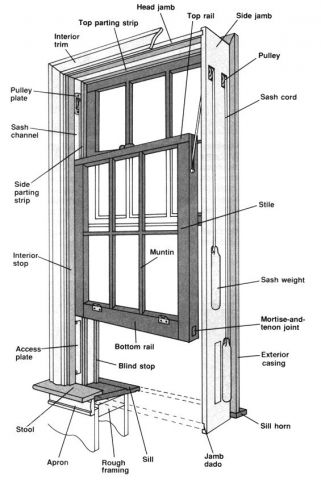
Window and Door Glossary
Active Panel Primary operating door panel.
Aluminum Surround The aluminum frame around a screen or energy panel.
Apron A piece of casing or decorative trim installed against the wall immediately beneath the stool of a window.
Argon Gas A colorless and odorless gas used to fill the airspace between insulating Low E glass. The addition of argon greatly increases the insulating performance of the Low E glass.
Assembly Single units mulled together.
Astragal A moulding applied to one stile of a French door, sliding French door, or French casement window unit which the other door panel or window sash strikes. Head and footbolt devices are usually found on the astragal side.
Authentic Divided Lites (ADL) Also known as True Divided Lite. Permanent stationary muntins and bars separate the glass in a window or door sash to give the sash two or more lites of glass.
Awning Window Unit A combination of frame and sash, hinged at the top of the vertical jambs which allows the unit to pivot from the top with the sash opening to the exterior of the building.
Balances A block and tackle system used in the jamb liner of double hung or single hung units.
Bars A narrow rabbeted, horizontal or vertical sash or door member in an authentic divided lite unit, extending from rail to rail or stile to stile along the total length or width of the glass opening.
Bay Windows A series of windows installed in a bay which is two flanker units and a center sash. A bay may be an arc or a polygon. When a bay is or closely approaches an arc, the window is termed a bow. See Bow Windows.
Blindstop The frame member on a double hung window located between the jambs and the casing. The blindstop forms a rabbet that supports either a storm sash or screen.
Bow Windows A series of adjoining window units, installed on a radius.
Brick Mould Casing (BMC) An exterior moulding of window and door frames that abuts the exterior facing material of the structure. The casing serves as the boundary moulding for brick or other siding material and also helps to form a rabbet for screens and/or storm sash or a combination door.
Cam Lock A lever operated lock which is used to prevent intrusion through the sash. Cam locks and keepers are installed on the jambs and stiles of casement and awning windows.
Cam Pivot A zinc pivot pin attached to the top and bottom sash stiles of double hung units (bottom sash on single hung units). Cam pivots rest on the clutch system of the balance tube assembly which allow opening and closing of the sash.
Combination Storm A wood or aluminum storm sash with self-storing screen and operating glass panels. Available for double hungs, gliders, and wood swinging doors, these panels are removable.
Combination Window A wood or clad wood frame storm sash with self-storing screen. Bottom glass panels such as those installed on a double hung unit operate by moving the plungers in and sliding the glass panel up to the desired position. Side glass panels such as those installed on gliders slide to the left or right to the desired position. All inserts are removable from the inside.
Composite Windows Windows made from a blend of materials, typically combining wood fibers with thermoplastic polymers or other engineered materials. Composite frames are designed to offer better dimensional stability and rot resistance than wood while providing a more natural appearance than vinyl. Performance and longevity vary significantly between manufacturers, so it is important to ask what specific materials are used in the composite blend and how the product performs in independent testing.
Condensation Resistance (CR) A measurement of how well a window resists the formation of condensation on its interior surface. Rated on a scale of 1 to 100 by the NFRC, with higher numbers indicating better resistance. Condensation resistance matters most in cold climates and in homes with higher indoor humidity levels. It is not a required rating on NFRC labels but is included by many manufacturers as an optional metric.
Cottage Window A window with unequal sash, top and bottom.
Daylight Opening (DLO) The width and the height of the visible glass.
Depth of the Jamb The point where the exterior casing ends to the point where the interior casing begins. On clad units, the point from the backside of the nailing fin to the interior of the frame.
Direct Glaze Refers to a window with no sash. The glass is glazed directly into the frame and is stationary.
Divided Lites Division of light by the use of muntin bars. There are several types:
- Authentic Divided Lites (ADLs): Single or insulating glass, individually glazed between the muntin bars.
- Simulated Divided Lites (SDLs): Muntins permanently adhered to the interior and exterior of the glass.
- Grilles: Wood muntins fastened to the interior of the sash to create the effect of divided lites, removable for easy glass cleaning.
- Spacer Bar: Tiny aluminum bars inserted between SDL muntins to emulate ADL.
- Grilles Between Glass (GBGs): Aluminum flat or contour bars that divide the glass visually. Because the grille is between the glass, grilles do not become misplaced or damaged. Cleaning is easy without small panes of individual lites.
Double Hung Double hung windows have two movable sash which operate vertically. Double hung sash are held in an open position with the use of coil spring block and tackle balancing devices.
Double Hung Tilt Pac A specially designed, made-to-order package which includes everything needed to replace double hung sash and hardware in an existing frame without changing the frame. This product has the same tilt feature as standard double hung windows.
Drip Cap A formed aluminum or vinyl piece which is installed at the top of windows and doors that allows water to run off the casing of the unit instead of seeping around the casing and into the unit.
Electric Operator An electrically operated device which will open casement or awning units by using a switch. This is used in lieu of a roto gear crank or pole crank.
Energy Panel (EP) A piece of glass, annealed or tempered, and finished on the edges by a surround. Energy panels are applied to windows or doors and rest on the glazing stop. They offer the homeowner added energy efficiency.
Energy Star Certification (Windows and Doors) A voluntary certification program administered by the U.S. Environmental Protection Agency that sets minimum energy performance standards for windows, doors, and skylights. Products must meet specific U-factor and SHGC thresholds that vary by climate zone. The EPA divides the United States into four climate zones (Northern, North-Central, South-Central, and Southern), each with different performance requirements. Colorado falls in the Northern zone, which prioritizes low U-factor for heat retention. Energy Star certification is a minimum standard, not a guarantee of premium performance. Many high-quality windows significantly exceed Energy Star requirements.
Escutcheon A decorative door handle plate attached to the stile directly behind the handle(s). Generally square or rectangular shaped.
Espagnolette Tilt-Turn hardware which houses the gear mechanism for the Tilt-Turn, inswinging casement, and hopper handles.
Extrusion An article or product of vinyl or metal made by the process of extruding. Extrusions include vinyl sill and head jamb tracks, vinyl jamb liners, and aluminum cladding used on the exterior of clad units.
Fiberglass Windows Windows with frames made from glass fiber reinforced polyester (pultruded fiberglass) or fiberglass-reinforced polymers. Fiberglass expands and contracts at nearly the same rate as the glass it holds, which results in tighter seals, less stress on the glazing, and longer service life compared to vinyl or aluminum. Pultruded fiberglass (such as Marvin’s Ultrex material) is exceptionally strong relative to its weight and does not warp, rot, corrode, or conduct heat the way other frame materials can. Fiberglass windows typically cost more than vinyl but less than premium wood-clad products, and they offer the strongest overall combination of durability, thermal performance, and dimensional stability available in the residential market today.
Field Measurement Guide A form that is filled out prior to ordering replacement window systems with panning to ensure the correct sized unit is assembled at the factory.
Finger-Joint A series of fingers machined into the ends of two pieces of lumber to be joined together. They are then held firmly in position by adhesive. Finger jointed wood is very strong and has a lesser chance of warping than does a clear piece of wood the same length.
Flanker A term used to describe a side or lateral part of a multi-unit window assembly such as a bay or picture unit.
Flat Casing Flat, surfaced on four sides, pieces of pine of various widths and thicknesses for trimming door and window openings. The casing serves as the boundary moulding for siding material and also helps to form a rabbet for screens and/or storm sash or combination doors.
Footbolt A locking rod device installed vertically in the stile or astragal of a door or screen which when activated secures the panel or screen in a stationary position.
Frame The stationary portion of a window that encloses either the glass (direct glaze) or the sash (operating or stationary). A frame consists of the head jamb (top), sill (bottom), sub-sill, side jambs, jamb extension, brick mould or flat casing, and blindstop.
Frame Expander A flat aluminum extrusion used in conjunction with the 90 degree frame expander to provide a flat casing appearance for clad units.
French Casement A casement-styled unit with two sash in one frame providing a sense of openness unrestricted by a vertical mullion or stiles when both sash are open.
French Door Doors available in either inswinging or outswinging rectangular or arch top style choices, typically featuring divided lite patterns and wide stiles for a traditional appearance.
Friction Limiter A device used on Tilt-Turn windows to provide friction to the sash when in the swing position.
Full-Frame Replacement A window replacement method in which the entire existing window, including the frame, sill, jambs, and any exterior trim, is removed down to the rough opening in the wall. A completely new window unit with its own frame and nailing flange is then installed, insulated, and flashed. Full-frame replacement is necessary when the existing frame is damaged, rotted, warped, or out of square. It costs more than a pocket replacement but allows for proper insulation of the cavity around the window, correct flashing to prevent water intrusion, and the option to change the window size or style. Full-frame replacement is the preferred method when performance and longevity are the priority.
Glass Size (GS) The measurement of the actual glass, not the visible glass.
Glazing Installing glass into windows and doors. Single glass refers to glazing with a single piece of glass. Insulating glass uses two panes of glass separated by a spacer and hermetically sealed together with dead air space between the panes.
Glazing Bead Strips of profiled wood or vinyl used to hold the glass in position in the sash. Wood glazing bead is attached to the rails and stiles of the sash using staples, small nails, or vinyl barbs. A vinyl bead is held in place by extruded barbs positioned in the kerf.
Glazing Tape A two sided adhesive tape placed between the glass rabbet and the glass and/or the glazing bead and glass of some unit types.
Glider Horizontal operating units which have one sash fixed while the other glides open and shut horizontally.
Grilles Removable wood dividers made to simulate authentic divided lites. Grilles are often rectangular or diamond shaped and are easily removed for cleaning purposes.
Handing A term used to describe the right or left hand operation of a window or door.
Head Jamb The top member of a frame.
Headbolt A locking rod device installed vertically in the stile or astragal of a door or screen which when activated secures the door in a stationary position.
Historical A term used to define a window or door product meeting the requirements of historical renovation standards.
Impact-Resistant Glass A type of laminated safety glass designed to withstand high-velocity impacts from wind-borne debris during severe storms. It consists of two panes of glass bonded to an inner layer of polyvinyl butyral (PVB) or ethylene-vinyl acetate (EVA). When broken, the glass fragments adhere to the interlayer rather than shattering into the home. Impact-resistant glass is required by building code in hurricane-prone coastal regions but is also used in other areas for enhanced security, noise reduction, and UV protection.
Inactive Panel Secondary operating door panel.
Insulating Glass (IG) Two panes of glass separated by a spacer and hermetically sealed together with dead air space between the panes. The air space may be filled with argon or krypton gas for improved thermal performance. See also Triple Pane Glass.
Inswing French Door A French door with panels that swing to the inside. Available in one, two, three, and four panel configurations as stationary or operating units.
Interior Casing The casing trim used on the interior perimeter of the window or door. Generally supplied by others except in the case of round top casing which is factory supplied.
Jamb Extension A jamb-like member, usually surfaced on four sides, which increases or extends the depth of the exterior or interior window or door frame. Jamb extensions accommodate various wall thicknesses.
Jamb Liner Thin strips of wood attached to the head jamb, side jambs, and sill to accommodate various wall thicknesses. Common jamb depths are 4-9/16″, 4-13/16″, 5-1/16″, and 5-3/16″.
Keyed Cylinder Lock A lock providing an exterior entry and locking convenience.
Krypton Gas Inert gas known for its ability to provide insulating properties in a small air space. Krypton is denser than argon and provides better thermal performance, but costs significantly more. It is most commonly used in triple pane glass units where the air spaces are narrower.
Laminated Glass Glass composed of two sheets of glass fused together with a sheet of transparent plastic between the sheets. When broken, laminated glass will generally not leave the opening. See also Impact-Resistant Glass.
Laminating A method of gluing strips of thin clear wood to the lengthwise surfaces of finger jointed material to provide the appearance of clear stock.
Lever Lock A lever handle and lever arm operator available as an option on awning units.
Lockset A complete door lock system comprised of the lock mechanism together with knobs, keys, plates, strikes, and other accessories.
Low-E Glass Low-E stands for low emissivity. The lower the emissivity, the higher the percentage of long-wave radiation blocked, thereby improving thermal performance. Low-E glass is coated with a thin, microscopic, virtually invisible metal or metallic oxide layer. The primary function is to reduce the U-factor by suppressing radiative heat flow. A secondary feature is the blocking of short wave radiation to impede heat gain. There are two basic types of Low-E glass: soft-coat (vacuum or sputter coated, used in insulating glass units) and hard-coat (pyrolytic, which can be used in both insulating and non-insulating applications).
Low-E II Glass A high performance Low-E glass providing the best winter U-value and warmest center glass temperature. It offers significant improvement in reducing solar heat gain coefficient values, providing one of the coolest summer glass temperatures of all Low-E products. Additionally, ultraviolet light transmission is greatly reduced. Low-E II coated glass products are specifically designed for insulating glass units, normally applied as a second surface coating.
Masonry Opening A brick, stone, or block opening into which a window or door unit is installed, including the outside casing.
Mortise and Tenoning A joinery system in which a projecting tenon on either the muntins or bars fits snugly into a mortise in either a bar, stile, or rail. This is the traditional method for assembling authentic divided lite units.
Mulling The act of attaching two or more window or door units together. The joint is then finished with a mullion center cap or mull trim.
Mullion The vertical member of a sash, window, or door frame between openings in a multiple opening frame. Common mullion configurations include space mull (units mulled together with a space left between) and stud pocket (units mulled with space for a support member between them).
Mullion Cover A clad cover for space mull usage on replacement window systems with panning. It covers a range from 3″ minimum to 10″ maximum.
Mullion Expander An aluminum extrusion designed to allow existing panning to be expanded to a wider width to accommodate a larger rough opening.
Mullion Reinforcement A reinforcement piece designed to be used on multiple casement, awning, and direct glaze assemblies to improve structural performance.
Multi-Lock Hardware An adjustable lock system used on French casement windows to ensure a tight seal of the sash frame components. It also provides a secure locking system.
Multi-Point Locking System A line of standard or optional multiple point locking mechanisms installed on the operative panel(s) or sash of various window and door products to enhance security and performance.
Muntins A short bar, horizontal or vertical, extending from a bar to a stile or rail, or to another bar. Muntins are the actual bars that create a pattern in the window.
Nailing Fin A factory installed vinyl strip that is inserted into a kerf in the frame of clad units. Nailing fin installation is the standard method used for installing clad units in new construction or full-frame replacement applications.
NFRC Rating A standardized performance rating system administered by the National Fenestration Rating Council, an independent nonprofit organization. NFRC labels appear on all windows, doors, and skylights sold in the United States and provide certified, independently verified ratings for U-factor, Solar Heat Gain Coefficient (SHGC), Visible Transmittance (VT), Air Leakage (AL), and Condensation Resistance (CR). Because NFRC ratings are tested under uniform conditions by accredited laboratories, they allow accurate apples-to-apples comparisons between products from different manufacturers. Always compare NFRC-rated numbers rather than relying on manufacturer marketing claims alone.
Non-Keyed Cylinder A handle without a keyed cylinder. The door cannot be locked from the exterior.
Obscure Glass Glass formed by running molten glass through special rollers. These rollers have a pattern on them causing the glass to become patterned and thus obscure.
One-Wide (1W) A term used to describe one frame with single or multiple sash or panels.
Operation Window drawings always illustrate the sash or door panels as viewed from the exterior. X means operating, O means stationary.
Operator An operating sash, panel, or unit.
OSM Outside Measurement.
Outswing French Door A French door with panels that swing to the outside. Available in one, two, three, or four panel configurations as stationary or operating units.
OX / XO The letters OX or XO identify the operation of window or door units as viewed from the exterior. The letter O stands for stationary while the letter X stands for operating.
Panel Either the stationary or operator wood frame with glass used on door products.
Panning A term used to describe the aluminum covering extrusion components (jambs, sill, and head jamb) used for replacement window systems.
Part Stop A strip of wood with weather-stripping attached which prevents air and water infiltration. Part stops are commonly found at the head jamb of a double hung unit.
Pitch A term used to describe the angle of a roof. For example, a 4-12 pitch indicates that the roof rises 4″ vertically for each 12″ horizontally.
Plinth Block A decorative wood block placed between the vertical casing and the top casing of a unit to provide an elegant interior casing profile.
Pocket Replacement Also called an insert replacement. A window replacement method in which the existing frame, sill, and jambs are left in place and a new window unit is fitted inside the existing opening. Pocket replacements work only when the existing frame is structurally sound, square, and free of rot or water damage. This method is less expensive and less disruptive than a full-frame replacement because the interior and exterior trim typically does not need to be disturbed. The tradeoff is a slightly smaller glass area (because the new window sits inside the old frame) and no opportunity to address insulation or flashing issues hidden inside the wall cavity.
Pole Crank An aluminum extension pole used to open or close roof windows or awnings which would be inaccessible because of their height.
Polygon A high level term used to describe triangles, trapezoids, pentagons, hexagons, and octagons in window shapes.
Prime The first coat of paint in an application that consists of two or more coats. Also refers to the paint used for such an initial coat (primer).
Pultrusion Lineal profiles of constant cross section manufactured by combining plastic resin and continuous glass fiber reinforcement. These thermally insulating and structural components are ideally suited for applications where strength, thermal stability, and weather resistance are required, such as in patio door frames and window frames. See also Fiberglass Windows and Ultrex.
Pyrolytic Low-E Glass (Hardcoat) Pyrolytic Low-E is designed to be used either in non-insulating applications such as energy panels that have exposed surfaces or for insulating glass applications. In some northern climatic situations where increased solar heat gain is desired over standard Low-E performance, this is a viable option. The increased solar heat gain that is desirable in winter may increase summer energy costs if the home is air conditioned. The pyrolytic coating is typically applied to the second surface but can be applied to the third surface to provide increased solar heat gain.
R-Value The resistance a material has to heat flow. Higher numbers indicate greater insulating capabilities. R-value is the inverse of U-factor.
Rabbet A groove along or near the edge of a piece of wood.
Radius The length of an imaginary line from the center point of a circle to the arc or circumference of a circle.
Rails The cross or horizontal members of the framework of a sash, door, or other panel assembly.
Relief Kerf Kerfs machined into the frame parts of a unit. Relief kerfs inhibit warping.
Retro-Sizing Refers to units which are sized for replacement purposes.
Rolled Aluminum A term used to describe aluminum profiles for screen and energy panel surrounds which are fabricated by the use of a roller or series of rollers to produce a desired profile.
Roller Cams Adjustable roller devices on multi-lock hardware installed on the sash of French casement units. When adjusted properly, they ensure a tight seal between the sash and frame members.
Rose A circular cover plate attached to the stile directly behind a knob or door handle. May be plain or have a decorative design embossed into the cover.
Roto-Gear A steel drive worm, gears, and crank device used for opening awning and casement units.
Rough Opening The opening in the wall where a window or door unit is to be installed. Openings are larger than the size of the unit to allow room for insulation and to shim the unit square.
Round Top Generally a semicircle window which is mulled to the top of another window or door, forming the round top appearance. Variations include full round tops, separated round tops, ellipticals, transoms, inverted corners, ovals, and Gothic heads. Round tops can be used separately or combined with other units.
Sash The operating and/or stationary portion of the window unit that is separate from the frame. The sash consists of stiles (vertical members), rails (horizontal members), check rails (horizontal members that meet, as in double hung units), bars (divisional members extending from rail to rail or stile to stile), and muntins (divisional members extending from a bar to a rail, stile, or another bar).
Sash Limiter A metal device which attaches to a casement sill and bottom rail, limiting the sash to a specified opening of 5, 10, 15, or 20 degrees.
Sash Lock A locking device which holds a window shut, such as a lock at the check rails of a double hung unit. Larger units utilize two locks.
Sash Opening (SO) The opening between wood frame members for both height and width, disregarding any jamb hardware tracks. This measurement is used predominantly when measuring an opening for replacement sash packages.
Sash Retainer Plate A nylon retainer plate used on double hung sash to secure the bottom sash.
Sash Width Horizontal measurement across the face of a sash.
Screen OM (Outside Measurement) The width and the height of a screen including wood or metal surrounds.
Screens A close-mesh woven screen material of metal or fiberglass attached to an aluminum or wood surround. Screens inhibit entry of insects yet permit light, air, and vision. Most window and door products utilize full screens. Half-screens are available for single hung units.
Sequential Locking System A locking design used on casement windows where the lower lock activates first, moving the sash to the weatherstrip, and the top then engages to snug the sash to the frame.
SHGC (Solar Heat Gain Coefficient) A measurement of how much solar radiation passes through a window, expressed as a number between 0 and 1. A lower SHGC means less solar heat enters the home, which reduces cooling costs in warm climates. A higher SHGC allows more solar heat in, which can reduce heating costs in cold climates during winter. In Colorado and other Northern climate zone states, the ideal balance depends on window orientation. South-facing windows may benefit from a moderately higher SHGC to capture passive solar heat in winter, while west-facing windows typically perform better with a lower SHGC to reduce afternoon heat gain in summer. SHGC is one of the key metrics on an NFRC label and is a required threshold for Energy Star certification.
Side Jamb The side (vertical) member of a frame.
Sidelite A stationary glass panel mulled to or installed next to a door.
Sill The horizontal member forming the bottom of a window or exterior door frame. The lowest member of the frame of a structure, resting on the foundation and supporting the frame.
Sill-Horn The extension of the lip of a window sill to the outside edge of the casing.
Single Hung A window very similar to a double hung window, except that the top sash is stationary or non-operable.
Sliding French Door A sliding door utilizing French door style panels.
Slope The measure of the tilt of a line; rise over run.
Snubber An interlocking metal bracket attached at the center of the hinge side of a casement sash and frame. It pulls the sash tightly against the frame weather-strip to maximize performance.
Spacer Used to separate the two pieces of glass in an insulating glass panel.
Square Foot For measuring the area of a unit. Rough opening width (in inches) multiplied by rough opening height (in inches), divided by 144, equals the area in square feet.
Stabilizer Arm An optional piece of hardware for Tilt-Turn windows which is attached to the header and top rail corner drive on the handle side to limit the travel of the sash when operated in the tilt mode. It is automatically disengaged when the sash is swung in the turn mode.
Starburst A semi-elliptical area where the lower center is the point where dividing spokes meet and radiate outward. May be constructed of glazed sash, removable grilles, ADL, or SDL.
Stationary A non-operating sash, panel, or unit.
Stationary Sash Bracket A 90 degree L bracket used to secure stationary casement and awning sash to the frame. The sash can be removed for replacement by removing the wood stops and bracket screws.
Stiles The upright or vertical perimeter pieces of a sash, panel, or screen.
Stool A horizontal trim member that laps the window sill above the apron and extends beyond the interior casing. See Apron.
Storm Sash A wood framed assembly containing non-removable glass. The storm sash is removed during the summer and replaced with a wood framed screen.
Structural Masonry Brackets Installation brackets used with multiple high or wide window units or large doors for added structural support. The brackets are also used to attach the unit in the rough opening in lieu of nailing through the casing.
Sub-Sill The supplemental member of a frame used under most awning and casement units as an additional sill, with the primary purpose being to hold multiple units together at the sill.
Sunburst A semi-elliptical area where the lower center contains a sun-like figure with rays radiating outward. May be constructed of glazed sash, removable grilles, ADL, or SDL.
Surround An attractive, protective trim secured to an energy panel by adhesive or vinyl barb to give the glass panel a safe finished edge. Also the aluminum framework for most standard screens.
Tempered Glass Float glass panels heated and then cooled rapidly in a controlled environment. This process makes the glass several times stronger than regular glass. It also makes it safer because when broken it yields small pebble-like fragments rather than sharp shards.
Template A pattern of a window unit from which dimensions and measurements can be determined. Round tops require templates for replacement units.
Three-Wide (3W) A term referring to any product or unit when three separate frames are mulled together as a multiple unit.
Tilt-Pac A specially designed, made-to-order package which includes everything needed to replace double hung sash and hardware in an existing frame without changing the frame.
Transom A window above a window or door. Transoms can be either stationary or operating.
Triple Pane Glass Also called triple glazing. An insulating glass unit consisting of three panes of glass separated by two sealed air spaces, each of which may be filled with argon or krypton gas. Triple pane windows offer significantly better thermal performance (lower U-factor) and noise reduction compared to double pane units. The tradeoff is higher cost, greater weight (which affects hardware and structural requirements), and slightly reduced visible light transmission. Triple pane glass is most cost-effective in extremely cold climates or in homes where noise reduction is a priority. In Colorado’s climate, high-quality double pane Low-E glass with argon fill often provides a strong balance of performance and value, though triple pane is becoming more common in high-end projects.
Turn Button A vinyl or aluminum button and screw used to secure wood combinations, storm sash, and wood screens to the exterior casing or energy panels to the sash or door panel.
Two-Wide (2W) A term referring to any product or unit when two separate frames are mulled together as a multiple unit.
U-Factor A measure of total heat flow through a window or door from room air to outside air. Lower numbers indicate greater insulating capabilities. U-factor is the inverse of R-value and is one of the most important metrics on an NFRC label. For Energy Star certification in the Northern climate zone (which includes Colorado), windows must meet a maximum U-factor threshold.
Ultrex A pultruded composite material made of polyester resin and glass fibers, developed and manufactured by Marvin. This material is used in Infinity by Marvin and other Marvin product lines. See also Fiberglass Windows and Pultrusion.
Unit One single product, such as a one-wide casement window.
Vinyl Glazing Bead A vinyl extrusion used on clad units which serves the same purpose as a wood glazing bead for wood units.
Vinyl Windows Windows with frames made from polyvinyl chloride (PVC), a thermoplastic polymer. Vinyl is the most affordable frame material available and offers reasonable insulating properties because PVC does not conduct heat as readily as aluminum. However, vinyl frames expand and contract significantly with temperature changes, which can stress seals over time and affect long-term performance. Vinyl is available in white and a limited range of colors, though color options have expanded in recent years. Quality varies considerably between manufacturers. Premium vinyl products with multi-chamber frame designs and fusion-welded corners perform significantly better than entry-level vinyl with single-chamber construction and mechanically fastened joints.
Visible Transmittance (VT) A measurement of how much visible light passes through a window, expressed as a number between 0 and 1. Higher numbers mean more natural daylight enters the home. A VT of 0.50 means 50% of visible light is transmitted through the glass. Low-E coatings reduce VT slightly in exchange for better thermal performance, so there is always a tradeoff between energy efficiency and natural light. Most residential Low-E windows have a VT between 0.35 and 0.55. VT is one of the optional metrics reported on NFRC labels and is worth comparing when evaluating windows for rooms where natural light is a priority.
Weather-Stripping A strip of resilient material designed to seal the sash and frame members in order to reduce air and water infiltration.
Wire Glass Glass with wire embedded into the glass when it is still in a molten state. This prevents the glass from falling out of the sash if it should break.
Wood-Clad Windows Windows with a wood interior frame protected by an exterior cladding of aluminum, fiberglass, or vinyl. The wood interior provides a warm, paintable or stainable finish for the living space, while the exterior cladding eliminates the need for exterior painting and protects the wood from weather exposure. Wood-clad windows offer the broadest range of design options, including custom shapes, sizes, profiles, and divided lite patterns. They are typically the most expensive frame option and are most commonly specified for architecturally detailed homes, historical renovations, and projects where interior aesthetics are the primary consideration. Major wood-clad manufacturers include Marvin, Andersen, and Pella.